

Rewilding in the Flemish Ardennes
"Imagine a spring morning—with dew still on the grass—when a majestic elk takes its first step across our national border. And decides to stay. Picture a meandering river where a meter-long sturgeon seeks its way to the open sea, silently passing a herd of wild water buffalo. Could this be our land in twenty years? We believe it’s possible if more people read and learn about rewilding, experience wild nature, and embrace it in their hearts."
The inspiration for the project comes from the remarkable book Rewilding in Our Own Land by Jeroen Helmer. Helmer has been an illustrator for Ark, a Dutch organization dedicated to creating robust and dynamic natural areas where natural processes can unfold freely, since its founding fifty years ago. Jeroen’s stories are used worldwide by scientists and practitioners of rewilding.
The project primarily supports the impact of extensive grazing on the landscape, vegetation, and biodiversity. Over time, plant and animal species have adapted to the grazing patterns of grazers. In a sense, they have co-evolved with grazing. Consider plant seeds that require open patches created by grazers to germinate, insects that depend on the dung heaps of grazers, or seeds that spread by clinging to the fur of cattle. During the evolutionary process, countless animals and plants claimed their natural place in the grazed landscape. In every nook or landscape transition, there was a plant that could grow there, or an insect species that could survive in that exact spot. Take, for example, the group of grasshoppers. Some grasshopper species prefer to live in tall grass, while others thrive in short grass, bare soil, shrubs, trees, thickets, marshes, flower-rich fields, or wet grasslands. In short, dozens of grasshopper species have co-evolved with the open landscape, each finding its own niche.
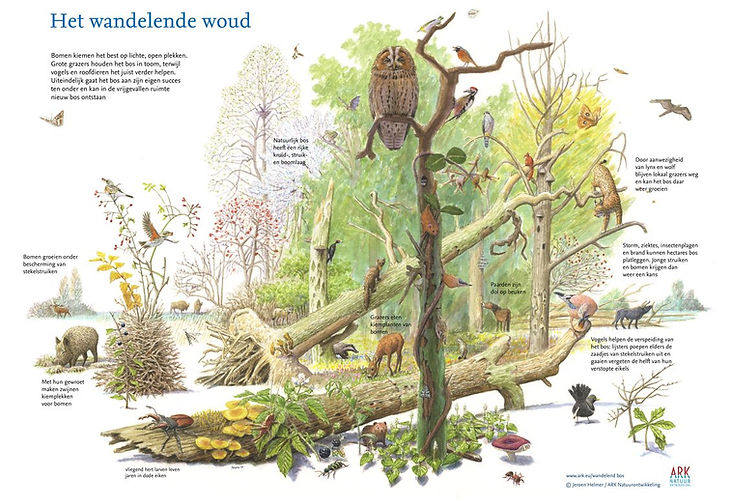
De veerkracht van de natuur is enorm als je grazers op een evenwichtige manier terugbrengt in de natuur. Door de begrazing wordt de diversiteit aan open en halfopen landschappen met vele overgangen weer veel groter. Zowel de sprinkhaan die houdt van lang gras, als de sprinkhanen die houden van kort gras, struiken, bloemen, kale plekken, ruigtes, schaduwplekken, zonnige plekken, natte en droge plekken. Allemaal hebben ze in het gevarieerde landschap opeens weer een leefgebied. En dat geldt voor alle planten en dieren. Zo keren vaak lang verdwenen bloemen, planten, zoogdieren, vogels, kevers, vlinders en talloze andere insectensoorten weer terug. Gewoonweg omdat er weer een geschikt leefgebied voor ze is. Met het project : Verwildering in de Vlaamse Ardennen beogen we een fraaier, bloemrijk open landschap met een veel grotere soortenrijkdom, een inspiratie bron voor klein, groot en de aankomende generaties.


Our project is made possible by ...


